Project management on Kanban boards
Your project's work, the project meeting, the risks and the planning, on boards that work together. You can have up to 3.
Does this sound familiar?
What is project management?
Project management is organising a project so that the result is delivered, on time and with the people available. It comes down to three things: agreeing what needs to happen, seeing how things stand, and changing course when needed.
That sounds simple, and it is, as long as you have the overview. Most projects do not go wrong because of one big mistake, but because of small things that surface too late: a delivery that is delayed, a drawing that is slow to arrive, a decision nobody takes.
Keeping track of a project's work
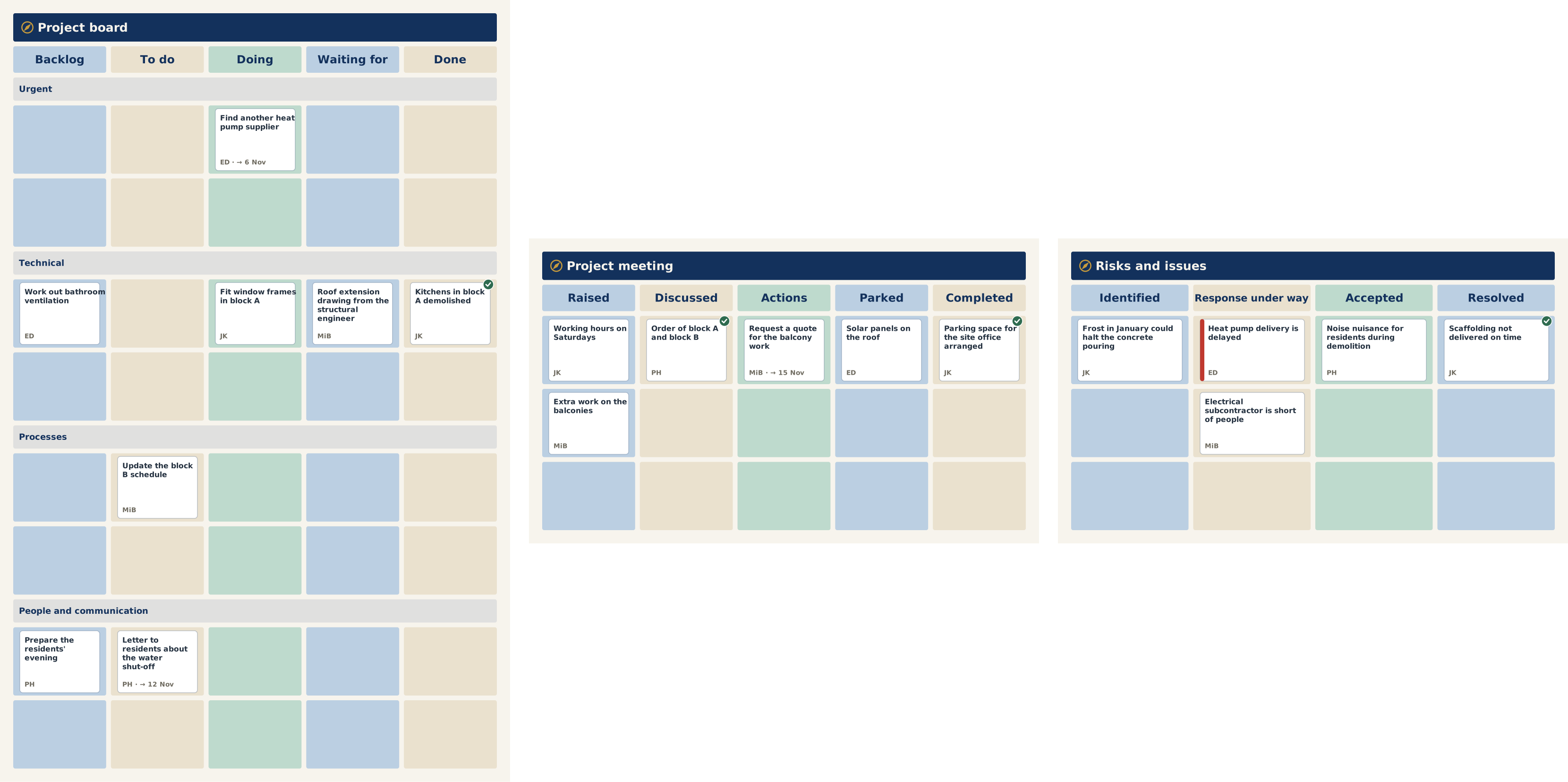
Put the project's work on a board, with the name of whoever is doing each card. Start with To do, Doing and Done, and a column for work that is waiting on someone else. If the project runs in several workstreams, such as technical, processes and communication, use a swimlane for each one.
An example: a renovation project
A construction project team is renovating an apartment block. On the project board, under Technical, the bathroom ventilation is in the backlog, fitting the window frames in block A is in Doing, and the roof extension drawing is in Waiting for: it has to come from the structural engineer. Under People and communication is the letter to residents about the water shut-off, with a date. And at the top, under Urgent, finding another supplier for the heat pumps.
Milestones: what is a milestone and how do you plan them?
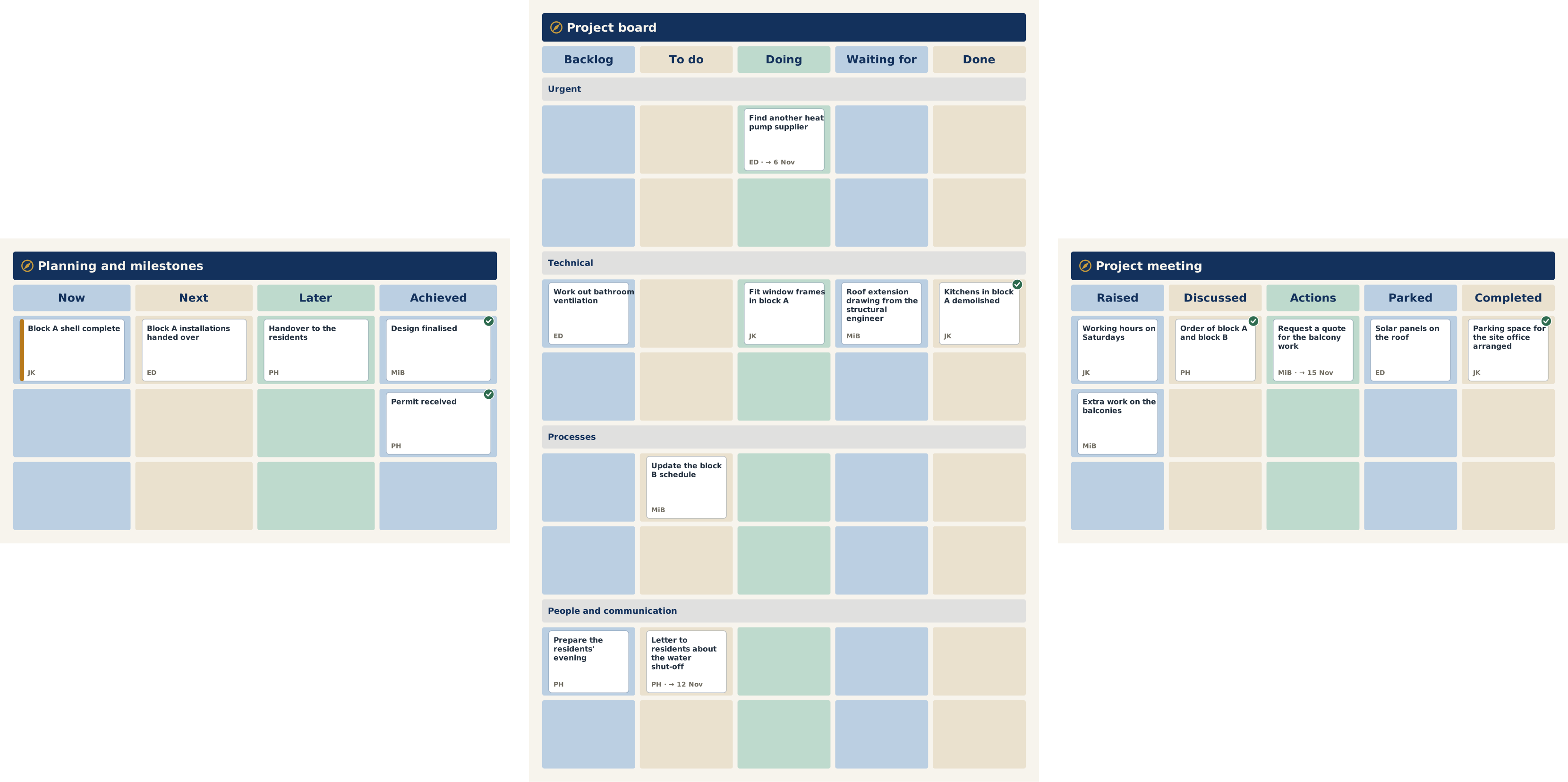
A milestone is a point in the project by which something must be finished. A milestone is not work, but a point at which you can see whether the work is on track: design finalised, permit received, shell complete, handover to the residents.
Making a milestone plan
Start at the end: when does the result need to be there? Work back to the points by which something must be finished to get there. Put them in Now, Next and Later, or in phases. The colour of each card shows whether the milestone is on track.
When a milestone is missed
Discuss it straight away: why not, what is the consequence, and what do we decide? Do not quietly move the date. A milestone that slips unnoticed takes the rest of the project with it, and somebody only notices when it is too late.
The project meeting and the steering group
The project meeting
In the project meeting, the team discusses the work: what is stuck and who does what. Start with what is stuck and what needs attention. Make sure every topic ends in a decision, an action or next time. That keeps the meeting short.
The steering group
A steering group takes the decisions the project team cannot take itself: about money, people, time and direction. The project team does the work. A good steering group hears in good time what is going on, so there are still choices to make. A steering group that only hears things are going wrong once they already have can only limit the damage.
What goes to the steering group
Anything beyond the team's authority: a milestone that will be missed, a risk with consequences for the budget, a choice between two directions. Put it on the steering group's agenda with a proposal, not just the problem.
Risks and issues in a project
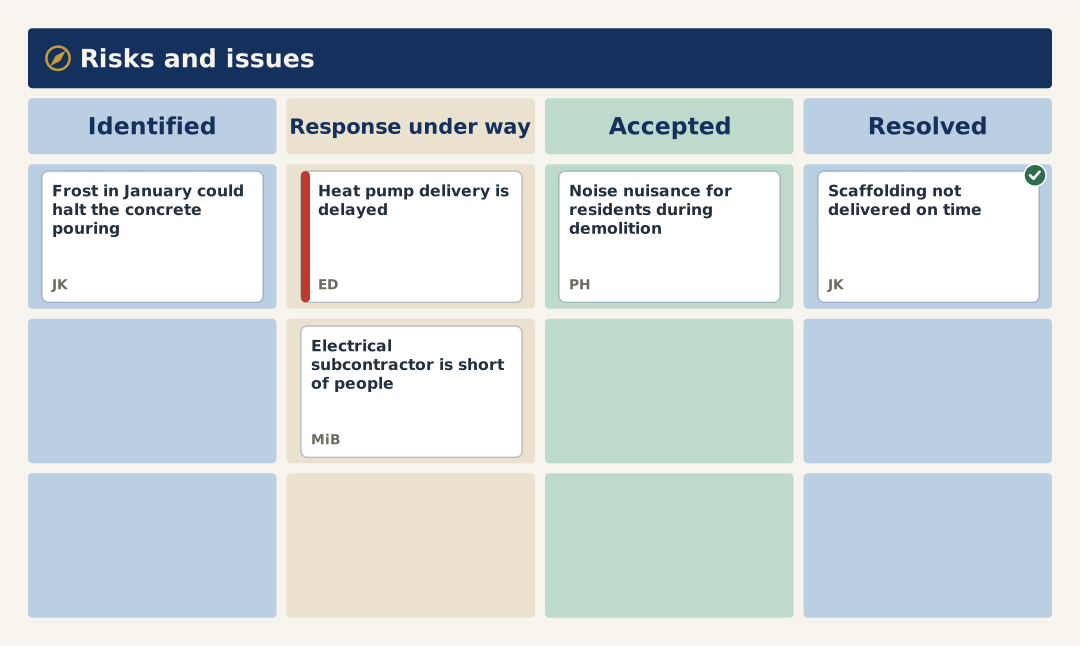
A risk could still happen. An issue is already here. For a risk, you look for a measure to prevent it; for an issue, a solution. Keep track of them together, on a board the team reviews every month.
A measure against a risk is work. Put it on the project board, with a name and a date. Then it does not get lost among the other work. More on this on the page about the risk register.
Several projects at the same time
Does your team have a few projects running at once, and not every project is big enough for its own board? Then put all the projects on one board, with who leads each project and how it is doing. Every month, discuss which projects come first and what you stop doing.
Not too many at once
Set a limit on the number of projects running at the same time. A new project only starts when another one is finished or stopped. Teams that run too many projects at once finish all of them later.
Your project on 3 boards
The project meeting
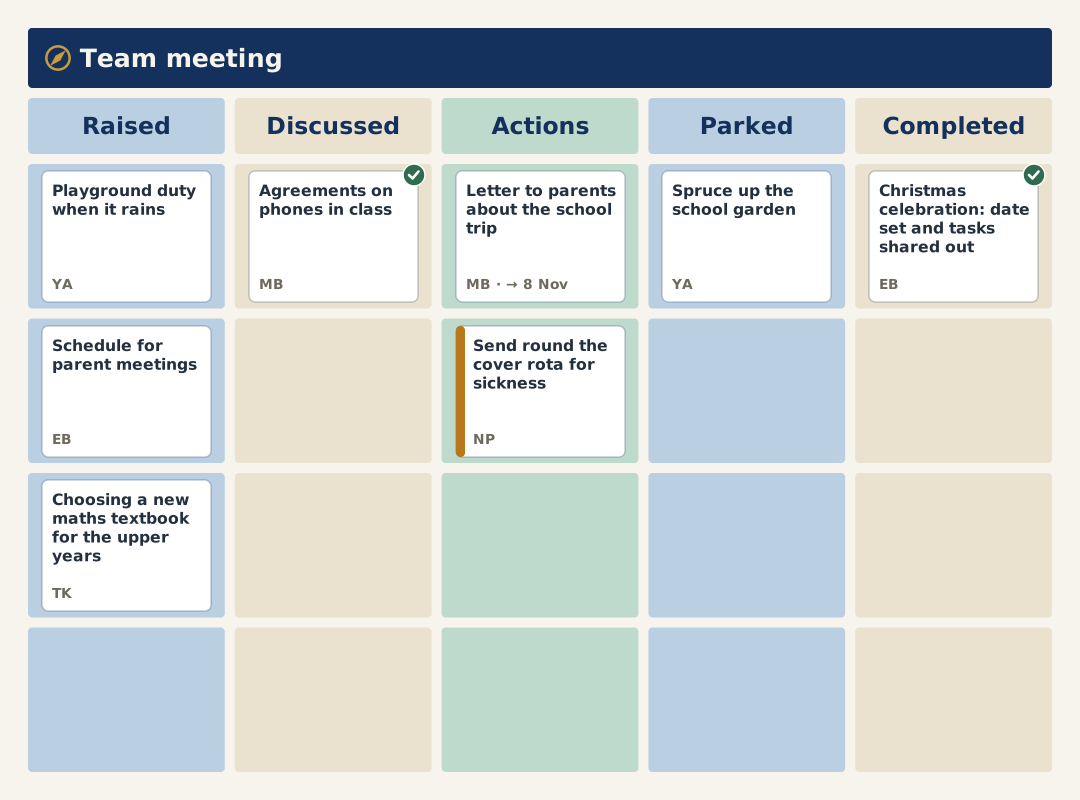
On the Project meeting board, every card is a topic that someone raises. Whatever is in Raised is on the agenda for the next meeting automatically.
Actions from the project meeting and measures against risks go on the project board. Anything that gets stuck goes to the project meeting.
A second meeting can be added to the Project meeting board: the steering group, every month (or every quarter). You switch it on when you create the boards.
Several projects at once
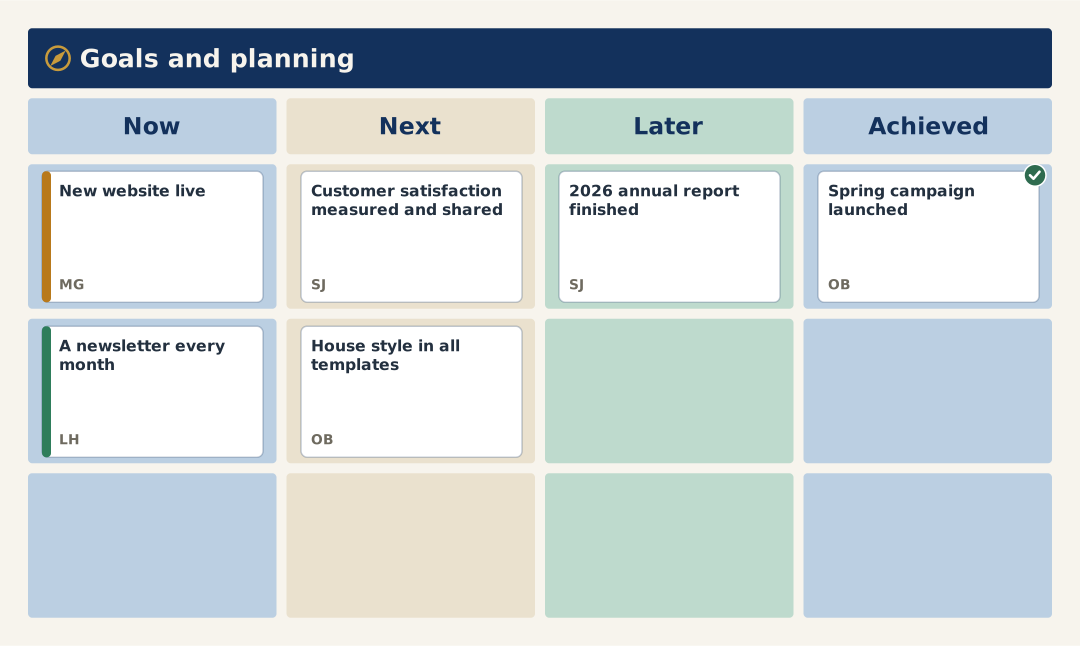
Are a few projects running at once, and not every project is big enough for its own board? Then put all the projects on one board with the Goals and planning way of working. Each card is a project. The columns are Now, Next, Later and Achieved.
The colour of the card shows whether the project is on track, needs attention or is behind.
You go through the projects every month, with a meeting every quarter to choose again what goes in Now.
More than 3 boards
If you need more than 3 boards, Obeya is a better fit.
Questions about project management
What is project management?
Organising a project so that the result is delivered, on time and with the people available. It is about making agreements, seeing how things stand and changing course when needed.
How do you keep an overview when your team has several projects at once?
Put all the projects on one board, with who leads each project and how it is doing. Every month, discuss which projects come first and what you stop doing.
Which columns go on a project board?
Start with To do, Doing and Done. Add a column for work that is waiting on someone else. If the project runs in several workstreams, use a row for each workstream.
What does a steering group do?
A steering group takes the decisions the project team cannot take itself: about money, people, time and direction. The project team does the work.
What is the difference between a project meeting and a steering group?
In the project meeting, the team discusses the work: what is stuck and who does what. The steering group takes the decisions that go beyond the team.
What is the difference between a risk and an issue?
A risk could still happen. An issue is already here. For a risk, you look for a measure to prevent it; for an issue, a solution.
What is a milestone?
A point in the project by which something must be finished. A milestone is not work, but a point at which you can see whether the work is on track.
What do you do when a milestone is missed?
Discuss it straight away: why not, what is the consequence, and what do we decide? Do not quietly move the date. Record the decision.
How do you stop your team taking on too many projects at once?
Set a limit on the number of projects running at the same time. A new project only starts when another one is finished or stopped.
How do you keep project meetings short?
Start with what is stuck and what needs attention. Make sure every topic ends in a decision, an action or next time.
Other ways of working
Start Monday knowing why your work matters.
You pay per board, not per person: € 50 a month for 1 board, € 90 for 2 and € 120 for 3, excluding VAT. You pay online and can start right away.