Requests and reports: track customer questions and reports on one board
Questions and reports from outside the team, from arrival to resolution.
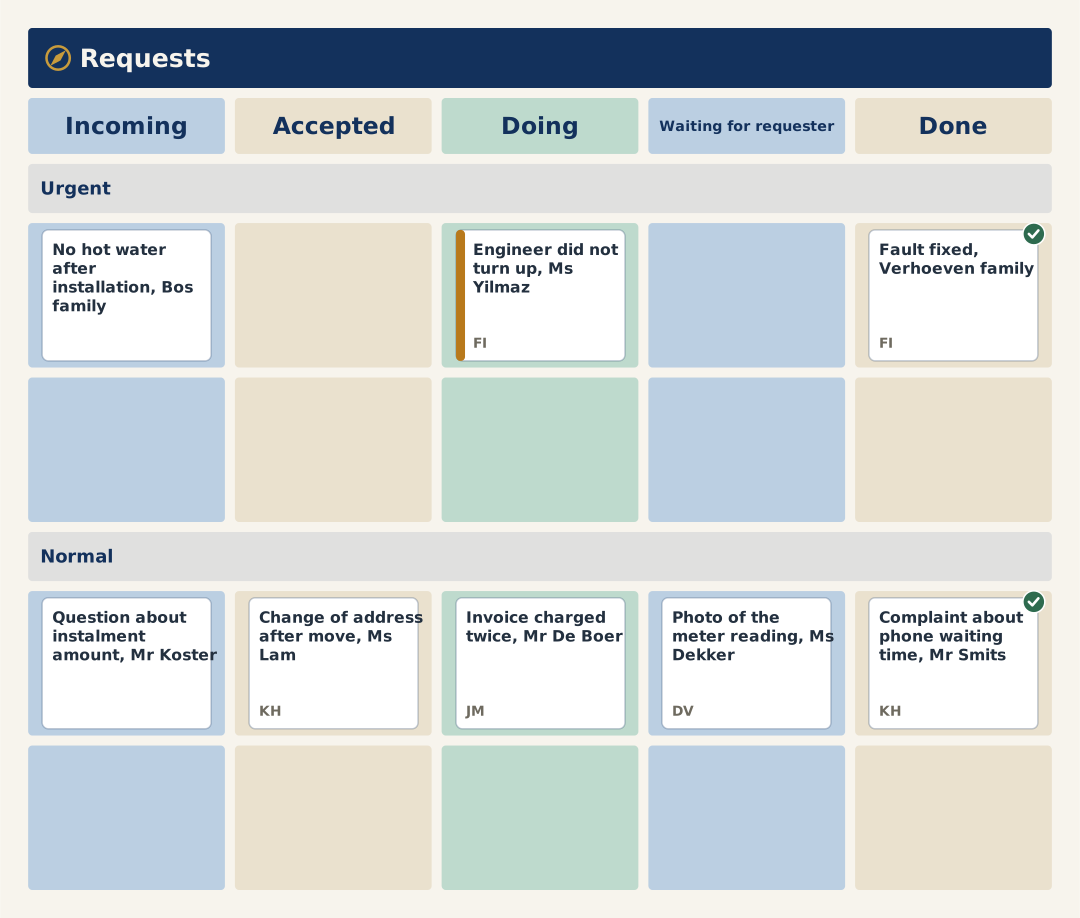
Does this sound familiar?
Tracking customer questions and reports in one place
In many teams, questions and reports come in by email, by phone, through a form and from the colleague who pops by. Everyone keeps their own list. Whatever was urgent ends up at the bottom of the pile. And when the customer calls back, nobody knows where their question stands.
It helps to put everything in one place the whole team can see. Every question or report gets a card, from arrival to resolution. That way everyone knows what is waiting, what is urgent and who is working on it.
Who it is for
Any team that receives questions from outside: a customer service team, a service desk, a team that handles reports from residents or colleagues, a secretariat. It is about work that comes in and that the team does not plan itself.
A board for requests: the columns
- Incoming: new, not yet assessed. No owner yet.
- Accepted: we are picking it up.
- Doing: someone is working on it.
- Waiting for requester: we need something from whoever asked the question.
- Done: resolved.
Urgent and normal
Use two swimlanes across the board: Urgent and Normal. Then you can see at a glance whether anything urgent is waiting, and where it is. Urgent comes first, but agree what counts as urgent. If everything is urgent, nothing is.
An example from a customer service team
At the customer service team of an installation company, Incoming holds, in Urgent: no hot water after an installation. In Normal: a question about the instalment amount. In Doing, there is a report that the engineer did not turn up; it has an orange border, because the customer has already called twice. Waiting for requester holds a request for a photo of the meter reading. Whatever comes in has no owner yet. It gets one in the meeting.
Logging reports: what do you write down?
Logging a report does not have to be complicated. Write down enough to pick it up, and no more.
- What the problem is, in the words of whoever reported it: "no hot water after the installation".
- Who reported it, and how to reach them.
- When it came in.
- Whether it is urgent, and why.
Put the requester's name in the card's title, for example "Invoice charged twice, Mr De Boer". Then everyone can find the report again when the customer calls.
One card per question
If someone asks two questions in one email, make two cards. Otherwise the second question gets left as soon as the first has been answered.
What gets added while handling it
What has been done and what has been agreed belongs with the card. If a colleague takes over, or the customer calls back, everything is in one place. Nobody has to search someone else's inbox.
Assessing new requests: yes, no or when
Not every question needs to be picked up straight away. Assess new requests together, at a fixed time. Each request has three possible answers: we pick it up, we do not pick it up, or we pick it up later.
Whoever picks up a question becomes its owner. One person per report. Without an owner, a report gets left, because everyone thinks someone else is dealing with it.
Saying no is an answer too
Do not just leave a question the team is not going to pick up. Let the requester know it will not happen, or who they should go to instead. That is better than a question that sits in Incoming for months.
Following up reports: how to make sure nothing gets left
Look first at what has been waiting too long
In the meeting, start with what shows no recent progress: reports that have been in Doing for days, and questions the requester has not yet responded to. On a board you can see which reports have stalled, and with whom.
Agree what resolved means
A report is resolved when the person who asked the question has an answer. Not when the team thinks it is finished. Agree on this, and nobody will move a card to Done too early.
Discussing open reports
Every week is enough for most teams. A team with a lot of urgent work can also take a quick look every day at what has come in.
Common mistakes when handling reports
- Reports in five places. The inbox, the form, someone's own list. Then something always goes missing.
- No owner. Everyone sees the report, nobody picks it up.
- Everything is urgent. Then urgent no longer means anything.
- Finished too early. The team is done, but the customer still has no answer.
- Never saying no. Questions that are not picked up stay open indefinitely.
How it works in Midflyt
A card is a question or report from a customer, resident or colleague. The columns: Incoming, Accepted, Doing, Waiting for requester and Done. The swimlanes: Urgent and Normal.
Assess new requests: yes, no or when. Then anything urgent or at risk, and anything that has been waiting too long.
Requests meeting, every week (or every two weeks).
Questions about customer questions and reports
How does a team keep track of customer questions and reports?
In one place, where the whole team can see them. Every question or report gets a card, from arrival to resolution. That way everyone knows what is waiting and what is urgent.
Who is responsible for a report?
One person per report. Without an owner, a report gets left, because everyone thinks someone else is dealing with it.
How do you make sure no report gets left?
In the meeting, start with what has been waiting too long. On the board you can see which reports have stalled, and with whom.
How often should you discuss open reports with the team?
Every week. You then assess the new reports: do we pick it up, no, or when?
When is a report resolved?
When the person who asked the question has an answer. Agree in the team what resolved means, and nobody will move a card to Done too early.
Other ways of working
Start Monday knowing why your work matters.
You pay per board, not per person: € 50 a month for 1 board, € 90 for 2 and € 120 for 3, excluding VAT. You pay online and can start right away.